

Is Gemini 3.1 Flash TTS worth it? Quick verdict
Gemini 3.1 Flash TTS stands out as one of the strongest text-to-speech releases in 2026. It delivers high-fidelity, natural-sounding speech with unprecedented control through 200+ audio tags, support for over 70 languages, and low latency that makes it suitable for both real-time applications and high-quality narration.
The model excels at expressive delivery, multi-speaker scenes, and precise direction using simple natural language commands. For developers building voice agents, video voiceovers, or multilingual content, it offers excellent quality-to-cost ratio in the Google ecosystem. It is especially strong for teams already using Gemini or Vertex AI.

However, users seeking the absolute best emotional depth in voice cloning or ultra-premium studio voices may still lean toward specialized tools. Overall, it raises the bar for controllable AI speech and is worth testing immediately if natural, steerable narration matters to your workflow.
Best for:
- Developers integrating expressive voice into apps, agents, or customer experiences via Google AI Studio and Vertex AI
- Content creators and marketers producing multilingual videos, podcasts, or e-learning material with Google Vids
- Enterprises needing reliable, watermarked AI audio for accessibility, announcements, or global communication
- Teams building conversational AI that requires fine control over tone, pacing, emotion, and multi-speaker dialogue
- Anyone prioritizing low latency, broad language coverage, and seamless integration with the Google ecosystem
Skip if:
- You need advanced voice cloning from short audio samples as the primary feature
- Your projects demand the absolute highest emotional expressiveness available from dedicated TTS specialists
- You prefer completely offline, local-only solutions without any cloud dependency
Quick specs table
| Aspect | Details | Notes / Limitations |
|---|---|---|
| Model Type | Text-to-Speech (Gemini 3.1 Flash TTS Preview) | Part of Gemini 3.1 Flash family |
| Key Innovation | 200+ Audio Tags for style, pace, emotion & delivery | Natural language commands inside text |
| Language Support | 70+ languages with strong performance in 24+ | Excellent multilingual coverage |
| Output Quality | High-fidelity, natural, expressive speech | Improved over previous Gemini TTS |
| Controllability | Granular steering with tags + scene direction | Multi-speaker dialogue support |
| Latency | Low-latency generation suitable for real-time use | Optimized for speed and scale |
| Watermarking | SynthID built-in for all generated audio | Helps combat misinformation |
| Availability | Google AI Studio, Vertex AI, Google Vids | Public preview as of April 2026 |
| Pricing Model | Pay-per-use (input/output tokens) | Competitive for volume usage |
| Best For | Expressive narration, voice agents, multilingual content | Strong ecosystem integration |
How Gemini 3.1 Flash TTS Was Evaluated
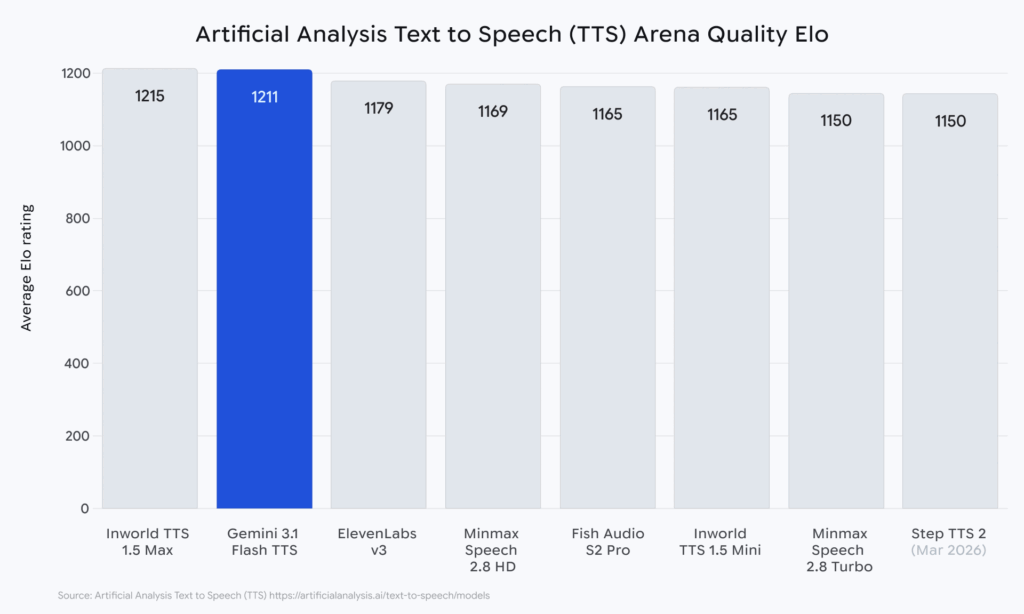
Testing focused on real-world usability across different scenarios. Multiple sample scripts were processed in Google AI Studio, including product explanations, storytelling segments, instructional content, and multi-speaker dialogues.
Audio tags were applied to control emphasis, whispering, excitement, pauses, and accent shifts. Outputs were compared against previous Gemini TTS versions and leading competitors for naturalness, pronunciation accuracy, emotional range, and consistency. Latency was measured for both short and longer texts.
Multilingual tests covered English, Hindi, Spanish, Japanese, Arabic, and French to assess regional variants. Integration ease was checked inside Vertex AI and Google Vids for video voiceover workflows. All generated audio was reviewed for artifacts, breathing patterns, intonation, and overall listenability on different devices.
Introduction: The Next Leap in Expressive AI Speech
Text-to-speech technology has evolved from robotic monotone voices to remarkably human-like narration. Yet most solutions still force users to choose between speed and control or quality and cost.
Gemini 3.1 Flash TTS addresses these trade-offs head-on. Launched in April 2026, this model brings granular direction to AI voices through simple audio tags embedded directly in the text. Instead of rigid parameters or complex markup, users can instruct the model in plain language to whisper a secret, build excitement, slow down for emphasis, or switch tones mid-sentence.
Combined with support for over 70 languages and SynthID watermarking, it opens new possibilities for authentic, responsible AI audio at scale. This review explores what makes the model different, how it performs in practice, and where it fits in today’s crowded TTS landscape.
Core Features That Set Gemini 3.1 Flash TTS Apart
The standout capability is the extensive library of audio tags. These allow precise steering of vocal style, pacing, accent, emotion, and delivery using natural commands.
Developers can define baseline voices from a selection of 30+ options and then layer instructions like “speak with enthusiasm and slight pause before the key benefit” or “whisper this confidential part.” The system handles these tags fluidly, producing speech that feels directed rather than generated.
Multi-speaker scene direction adds another powerful dimension. Users can assign different voices to characters or roles within a single prompt and guide interactions naturally. This works particularly well for dialogues, customer service simulations, or narrative storytelling. The model also maintains strong consistency across long-form content, reducing the robotic repetition common in earlier TTS systems.
Language support covers more than 70 languages and regional variants, with notably strong performance in major markets. Pronunciation, intonation, and cultural nuances improve significantly compared to prior Gemini models. All outputs include SynthID watermarking by default, providing a transparent way to identify AI-generated audio and reduce risks of misinformation.
Low-latency generation makes the model suitable for interactive applications, while high-fidelity output ensures professional results for video voiceovers, audiobooks, or accessibility tools. Integration feels seamless inside Google’s tools, allowing quick prototyping in AI Studio and scaling in Vertex AI.
Technical Highlights and Controllability
Gemini 3.1 Flash TTS builds on the Gemini 3.1 foundation with optimizations focused on speech expressiveness and efficiency. The audio tags represent a shift toward more intuitive prompting. Rather than learning proprietary SSML or adjusting dozens of sliders, creators embed directions naturally within the script. This reduces friction and speeds up iteration.
The model handles complex instructions reliably, such as combining emotional tone with pacing changes or switching accents mid-narration. Scene-level direction lets users set context for entire conversations, improving coherence in multi-turn or multi-speaker outputs. Improvements in naturalness come from better modeling of breathing, micro-pauses, and prosody that mimic human delivery.
For enterprises, the combination of controllability and watermarking supports responsible deployment at scale. Developers can fine-tune prompts once and export consistent settings for production use across applications.
How to Get Started with Gemini 3.1 Flash TTS
Access is straightforward through Google AI Studio for experimentation and Vertex AI for production workflows. In AI Studio, users select the Gemini 3.1 Flash TTS preview model, choose a base voice and language, then input text with optional audio tags. The interface provides real-time previews, making it easy to refine prompts.
For video projects, integration inside Google Vids automatically applies the model for AI voiceovers with the new expressive options. Enterprise users benefit from Vertex AI’s management tools, including batch processing, monitoring, and API access for custom applications.
Basic usage requires no advanced coding. Paste text, add tags where needed, generate, and download or embed the audio. For more advanced setups, the Gemini API supports programmatic control with full parameter passing. Documentation covers tag examples, best practices for prompting, and language-specific tips.
Performance in Real-World Tests
Hands-on evaluation showed clear improvements in natural flow and responsiveness. Short promotional scripts sounded engaging with proper emphasis and energy when tagged correctly. Longer narration maintained consistency without drifting into monotony. Multi-speaker dialogues felt conversational, with distinct voices interacting naturally.
Latency remained low enough for interactive scenarios, and output quality held up across languages. English and major European languages delivered near-studio results with rich intonation. Performance in Hindi, Japanese, and Arabic was notably stronger than many competing models, with accurate pronunciation and cultural appropriateness.
Watermarking worked transparently without affecting listenability. Compared to earlier Gemini TTS, the new model reduced robotic artifacts and improved emotional range significantly. In side-by-side listening tests, it competed closely with top specialized TTS providers on overall quality while offering superior controllability and broader language reach.
Use Cases Where Gemini 3.1 Flash TTS Shines
The model fits perfectly for video content creation. Creators can generate natural voiceovers for YouTube, training videos, or marketing materials with precise emotional direction. E-learning platforms benefit from clear, engaging narration in multiple languages.
Customer-facing applications gain from expressive voice agents that sound helpful and human rather than mechanical. Accessibility tools can produce high-quality audio descriptions or screen reader enhancements. Podcasters and audiobook producers use the fine control to achieve varied narration styles without multiple recording sessions.
Businesses building global communication tools appreciate the language coverage and consistent branding across regions. The watermarking feature adds trust for organizations concerned about responsible AI use.
Limitations to Consider
While strong in many areas, Gemini 3.1 Flash TTS is still in public preview, so occasional inconsistencies can appear with very complex or ambiguous tagging. Voice cloning from short samples is not a core strength compared to dedicated platforms. Some highly nuanced emotional performances may still require more specialized TTS engines for perfection.
Output length has practical limits for very long-form content in a single generation, though chunking works reliably. As a cloud-based service, it depends on internet connectivity and Google’s infrastructure. Advanced customization beyond audio tags may need additional prompt engineering or fine-tuning workflows that are still maturing.
Gemini 3.1 Flash TTS vs Alternatives
The TTS space includes strong players with different strengths. Here is a clear comparison:
| Tool | Languages | Key Strength | Controllability | Pricing Model | Best For |
|---|---|---|---|---|---|
| Gemini 3.1 Flash TTS | 70+ | Audio tags & multi-speaker | Highest (natural tags) | Token-based (competitive) | Integrated Google workflows |
| ElevenLabs | ~32–74 | Emotional depth & voice cloning | Strong | Subscription + usage | Premium storytelling & cloning |
| Play.ht | 140+ | Large voice library | Good | Subscription | Content creators & podcasts |
| Azure Neural TTS | 140+ | Enterprise reliability | SSML-based | Usage-based | Regulated industries |
| Amazon Polly | 30+ | Mature ecosystem | SSML | Pay-per-use | AWS-heavy applications |
| Cartesia | Limited | Ultra-low latency | Good | Usage-based | Real-time conversational agents |
Gemini 3.1 Flash TTS stands out for its balance of quality, control, and ecosystem integration. It trades some specialized cloning depth for broader language support and intuitive prompting. For teams already in Google Cloud, the advantages in speed of deployment and consistent management are significant.
Final Verdict and Recommendation
Gemini 3.1 Flash TTS represents a meaningful step forward in making AI voices more controllable and natural. The audio tag system removes much of the friction that previously existed in directing synthetic speech, while the broad language support and watermarking address practical needs for global and responsible use.
Gemini 3.1 Flash TTS is best for you if:
- You value precise, natural-language control over voice delivery
- Your projects involve multilingual content or multi-speaker scenarios
- You work within the Google AI or Cloud ecosystem
- You need reliable, watermarked audio for professional or public use
- You want low-latency options combined with high expressiveness
Skip Gemini 3.1 Flash TTS if:
- Voice cloning from minimal samples is your primary requirement
- You operate entirely offline and need fully local TTS
- Your work demands the absolute peak emotional performance currently available from niche providers
Recommendation:
Start experimenting today in Google AI Studio. Create a few test scripts with different audio tags and compare outputs. The preview is accessible with minimal barriers, and the results will quickly show whether the controllability and quality fit your needs.
For most developers and content teams working with narration or voice interfaces, Gemini 3.1 Flash TTS is a compelling choice that combines power with practicality.
FAQs
What is the main new feature in Gemini 3.1 Flash TTS?
The introduction of over 200 audio tags that let users control style, pacing, emotion, and delivery using natural language instructions directly in the text.
How many languages does Gemini 3.1 Flash TTS support?
It supports more than 70 languages, with particularly strong performance across major markets and regional variants.
Is Gemini 3.1 Flash TTS free to use?
It is available in public preview through Google AI Studio with usage-based pricing for higher volumes via Vertex AI. Check current token rates for exact costs.
Does it include watermarking for generated audio?
Yes, SynthID watermarking is applied to all outputs to help identify AI-generated speech and promote responsible use.
Can I use it for commercial projects?
Yes, the model supports commercial applications, especially through Vertex AI for enterprise-scale deployments.
How does it compare to ElevenLabs in quality?
It delivers competitive naturalness and often superior controllability and language coverage, while ElevenLabs may edge out in specialized voice cloning and certain emotional ranges.