
When I saw the announcement about Grok 4.3 Beta, I immediately got excited. xAI has quietly rolled out this new version to SuperGrok and X Premium+ users, and after digging into the details, I believe it brings some meaningful improvements that users will actually notice in daily use.
Grok 4.3 Beta keeps roughly the same scale as Grok 4.20, but it comes with a much better architecture. It now has a December 2025 knowledge cutoff, which means it is fresher than many competing models. What really caught my attention is the new ability to work inside a full computer environment. Users can now ask it to create PDFs, spreadsheets, and even run multi-step coding tasks directly.
I find this feature particularly useful because it moves Grok closer to being a real productivity partner instead of just a smart chatbot.
Here’s what stands out in the current beta:
- 2 million token context window – perfect for handling very long documents or complex projects
- Strong video analysis capabilities
- Sharp reasoning that feels more refined than previous versions
- Surprisingly high efficiency even at around 500 billion parameters
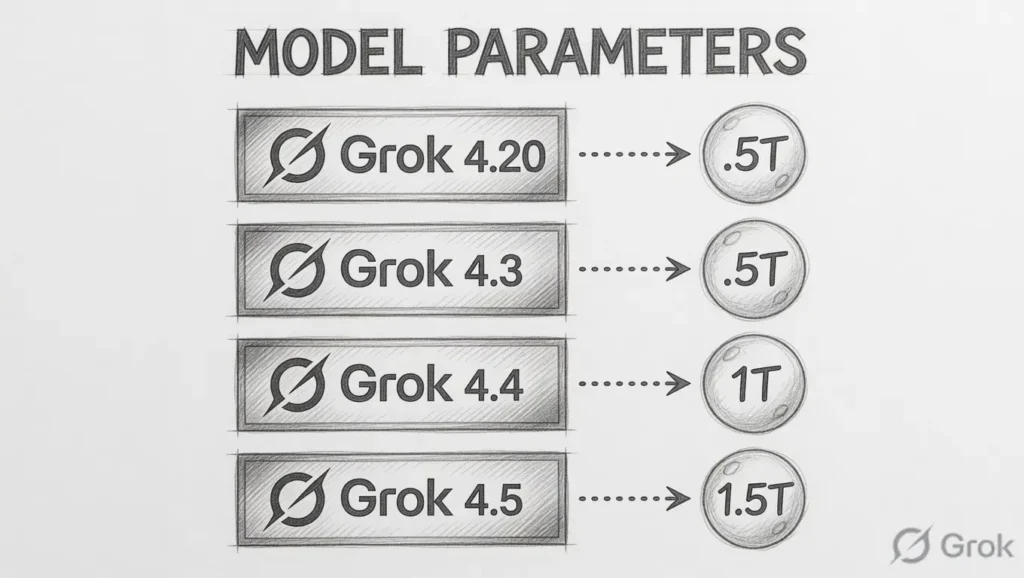
Elon Musk also shared an aggressive roadmap that I found quite ambitious. According to him, Grok 4.4 with 1 trillion parameters is expected by early May, followed by Grok 4.5 at 1.5 trillion parameters by the end of May. He even dropped a hint that Grok 5 might push toward AGI-level capabilities.
For me, this rapid scaling shows xAI is not slowing down. They are clearly aiming to close the gap with other frontier labs very quickly.
Quick Comparison of Recent Grok Versions
| Version | Parameter Scale | Knowledge Cutoff | Key New Ability |
|---|---|---|---|
| Grok 4.20 | ~500B | Earlier 2025 | Strong forecasting |
| Grok 4.3 Beta | ~500B | December 2025 | Full computer environment + tools |
| Grok 4.4 (Planned) | 1 Trillion | Expected later | Major reasoning jump |
| Grok 4.5 (Planned) | 1.5 Trillion | Expected later | Further capability leap |
Early feedback from users who already have access is mostly positive. Many say the reasoning feels sharper and the model handles long contexts extremely well. However, since it is still in beta, some small rollout issues and occasional inconsistencies are expected.
As someone who follows AI development closely, I think Grok 4.3 Beta is an important milestone. It proves that xAI can deliver meaningful upgrades even between major parameter jumps.
My Personal Take
In my opinion, the biggest change coming in the next few months is not just bigger numbers, but how these models will start feeling like actual collaborators. When Grok 4.4 and 4.5 land with trillion-parameter scale, professionals working in coding, research, content creation, and data analysis should prepare to integrate these tools deeply into their workflow.
What professionals should do right now:
- Start testing Grok 4.3 Beta if you have access
- Experiment with the new computer environment features
- Think about how 2 million token context can simplify your current projects
- Keep an eye on the May updates – they could change how you work
I believe the next 3-4 months will be very exciting. If xAI delivers on this roadmap, we could see a noticeable shift in how powerful and practical frontier AI becomes for everyday users.
This rapid progress makes me genuinely curious about what Grok 5 will eventually bring. For now, Grok 4.3 Beta already feels like a solid upgrade worth exploring.
FAQs
Who can access Grok 4.3 Beta right now?
It is currently available only to SuperGrok and X Premium+ subscribers.
What is the biggest new feature in Grok 4.3?
The ability to work inside a full computer environment, allowing it to create PDFs, spreadsheets, and run multi-step coding tasks.
When are Grok 4.4 and Grok 4.5 expected?
Grok 4.4 (1T parameters) is planned for early May, and Grok 4.5 (1.5T parameters) by late May 2026.
Does Grok 4.3 have a longer context window?
Yes, it supports a 2 million token context window, which is excellent for long documents and complex projects.
Is Grok 4.3 better than Grok 4.20?
It has the same scale but improved architecture, fresher knowledge cutoff, and new practical tools, making it noticeably better in real-world tasks.