
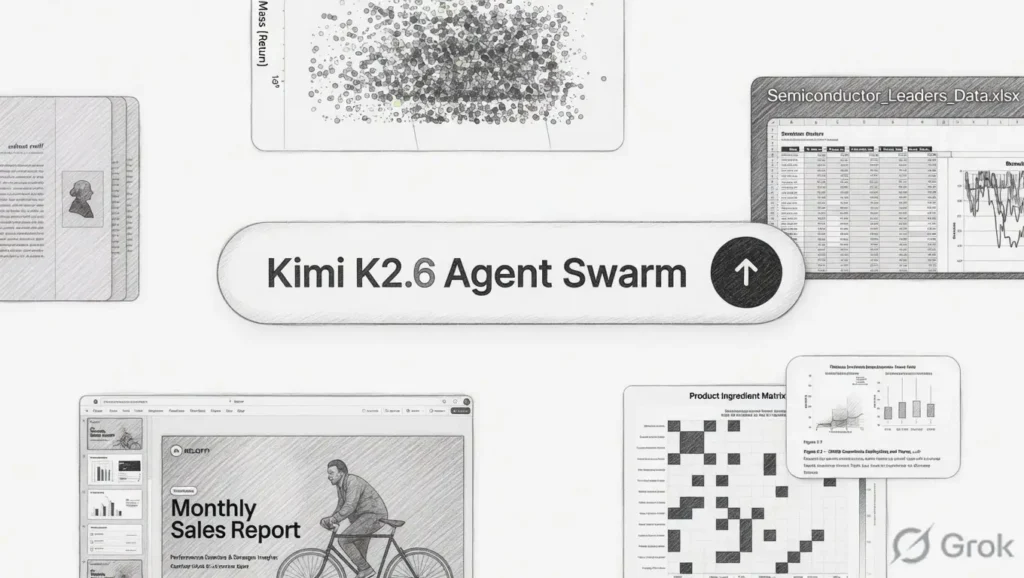
I spotted the release of Kimi K2.6 right after it launched on April 20 and it struck me as one of the strongest open models yet. This 1-trillion-parameter beast from Moonshot AI is not just another incremental update.
It tops several key leaderboards in coding, vision, and design while staying fully open-weight. That matters because it gives developers and teams real power without relying on expensive closed APIs.
Kimi K2.6 stands out for its smart Mixture-of-Experts design. It packs 1 trillion total parameters but activates only 32 billion per token. This keeps inference costs low while delivering frontier-level performance.
Users can now run the full model locally or through affordable APIs, making advanced AI accessible to more people than ever.
What Kimi K2.6 Brings to the Table
The model shines in practical, real-world tasks. It supports native multimodality for handling images alongside text. It also delivers strong results in long-context scenarios up to 256K tokens. Most importantly, it turns complex projects into manageable automated workflows.
Breaking Down the Benchmark Wins
Kimi K2.6 claims leading positions among open-weight models across tough evaluations. Here is a clear look at some standout scores:
| Benchmark | Kimi K2.6 Score | Comparison to Top Closed Models |
|---|---|---|
| SWE-Bench Pro | 58.6 | Beats Claude Opus 4.7 |
| SWE-Bench Multilingual | 76.7 | Matches or exceeds Gemini 3.1 Pro |
| HLE with Tools | 54.0 | Ahead of GPT-5.4 variants |
| BrowseComp | 83.2 | Strong web navigation edge |
| Toolathlon | 50.0 | Leads open models |
These numbers show consistent strength in coding, tool use, and multimodal reasoning. The model often matches or beats much more restricted closed systems at a fraction of the cost.
Agentic Superpowers That Matter
One area where Kimi K2.6 truly impresses is agentic performance. It can handle over 4,000 tool calls in a single run. It supports continuous execution for more than 12 hours without losing focus. On top of that, it coordinates up to 300 parallel sub-agents for breaking down massive tasks.
This setup lets the model tackle long-horizon projects like full-stack development or multi-step data analysis. Developers gain the ability to run autonomous agents locally or on cheap infrastructure.
Why Open-Weight Models Like This Change Everything
With weights freely available on Hugging Face, anyone can download and fine-tune Kimi K2.6. This levels the playing field for indie developers, startups, and researchers. It also encourages faster innovation because the community can inspect and improve the model directly.
I have seen how open models accelerate experimentation. This release pushes the entire field forward by proving massive scale and agentic capability do not require closed gates.
My Personal Take on What Comes Next
In my experience tracking these releases, Kimi K2.6 signals a clear shift toward truly usable open AI. What will happen is more teams will adopt local or low-cost agents for daily work.
What will change is the cost barrier for advanced automation. This will affect how quickly small businesses and creators can compete with larger players.
Professionals should start experimenting with the model now. Download the weights, test it on your workflows, and prepare integration plans. Those who build familiarity early will stay ahead as agentic tools become standard.
Overall, Moonshot AI has delivered something genuinely useful. Kimi K2.6 raises the bar for open-weight models while keeping them practical and affordable. The next few months will show just how quickly this changes real development pipelines.
FAQs
What is the parameter size of Kimi K2.6?
It uses 1 trillion total parameters in a Mixture-of-Experts setup with 32 billion active parameters per token for efficient performance.
When was Kimi K2.6 released and where can I get it?
Moonshot AI launched it on April 20 with full open weights available immediately on Hugging Face for local or API use.
How does Kimi K2.6 compare to closed models like Claude Opus?
It matches or beats them on several coding and agentic benchmarks while offering much lower costs and full openness.
What makes its agentic features special?
The model supports over 4,000 tool calls, 12-hour continuous runs, and up to 300 parallel sub-agents for complex long-horizon tasks.
Who should try Kimi K2.6 right away?
Developers, small teams, and researchers who want powerful coding and multimodal capabilities without high API fees will benefit most.